Showing posts with label Consequences. Show all posts

Tuesday, July 28, 2015

Stop Spanking! Prevention Solutions

Should You Spank Your Child? Behavior Solutions

Once again, I witnessed a parent yelling at their child at the store - then their anger escalating to a child being spanked. Believe me, spanking does not work. It may temporarily stop a child's behavior - but it leaves emotional scars, humiliation and anger.

The Pediatrics journal published a study that showed children who are spanked by their parents are at greater risk for later problems in both behavior and vocabulary. The Journal of Family Psychology published findings after 50 years of research was analyzed: "A new study on spanking, considered the most complete analysis to date on the topic, finds the more children are spanked, the more likely they are to defy their parents, exhibit anti-social behaviors and experience mental health and cognitive problems."


When adults spank children to get them to mind, too much has already gone wrong and the discipline has broken down. We know a big person should not hit a smaller person. Adults must set the example for good behavior. Therefore, you do not spit when you want a child to stop spitting, you do not yell when you want a child to stop yelling, and you do not hit when you want a child to stop hitting. Emotional scarring may result when a child is mistreated by an adult, whether verbally or physically.

Thursday, July 5, 2012

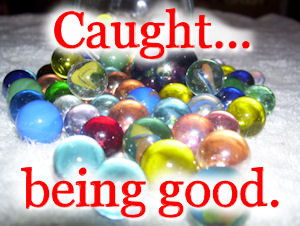
Caught Being Good

Do you want to raise a responsible well-behaved child? You can - by helping them develop good character traits. I still have parents thank me for giving them the idea to use a marble jar as a reward system. Our kindergarten classroom's jar was filled as the class received compliments from staff, parents, high school helpers, substitutes, i.e. anyone 16 or over.  It took about a month for the class to fill the jar. When it was full, my husband and daughter made cupcakes to celebrate. The children were so proud that they had earned those cupcakes, even though they only cost a few dollars to make. Other class rewards could be to let them vote on a short movie, take a long walk or play a new game outside, and extend center or recess time.


Behavior Management with Kids


For preschoolers, or at home, use a smaller jar so that it can be filled in about a week's time. The children can also learn math as you count the marbles. They will have a visual hands-on reward system. Let them help decide the reward. Sometimes spending special one-on-one time is much more beneficial than spending money. I was humbled when my daughter's kinder teacher told me that her favorite thing to do was to play dollhouse with me - no money or transportation was necessary, just some playful one-on-one time expanding our imaginations and relaxing in pretend play.

BUILDING GOOD CHARACTER
Children need to learn good character traits in order to gain respect and trust from those around them. Then they will gain a sense of pride in their abilities boosting self- confidence. You can encourage character growth in your child by using, recognizing, requiring, and emphasizing the right attitudes, words, and actions. This is best done by example. Communicate realistic age-appropriate expectations and hold your child accountable to teach responsibility.

The following is quoted from  PlayDrMom's Readathon post: "Positive reinforcement works … and also helps foster independence, life skills, and self-esteem.  It focuses more on mutual respect than power-differentials. Punishing (such as time-outs and taking away privileges) works too and it is sometimes needed, but if positive behaviors are reinforced regularly there will be less of a need for the punishments … and in turn less power struggles.... Implementing positive behavior strategies in daily family life can not only help eliminate problematic behaviors, but can give children a sense of control and help decrease parental stress.  Verbal praise, simply talking about progress made, and showing the pride you have in your children can go a long way in helping your child’s character development. "  To read the full article, click Promoting Positive Parenting.

To read my series on Discipline, click Prevent Inappropriate Behavior


Sisters displaying good character traits while reading: Sharing, caring, good example
  The truth of the matter is that you always know
the right thing to do. The hard part is doing it.”
~ H. Norman Schwarzkopf, Am. General

For a glimpse into Kindergarten see my book. Would you like inexpensive ideas, activities, and games to teach your child through play? Mommy with Selective Memory and I can help save your sanity, one project at a time, with The Happy Mommy Handbook: The Ultimate How-to Guide on Keeping Your Toddlers and Preschoolers Busy, Out of Trouble and Motivated to Learn. Both have been number 1 bestsellers on Amazon and are helpful gifts for parents and teachers. Also available on Barnes & Noble and Kobo.


What ideas would you like to add?

Follow me by:

eMailTwitterGoogle+PinterestRSSYou TubeFacebook

Tuesday, July 3, 2012

Tips for Enforcing Consequences

If your child is always perfectly behaved, stop reading! In fact, call me! Please guest post! But if you feel your child needs to understand that poor choices have a consequence, then this post is for you. Here are are some easy-to-implement ways of enforcing consequences:

  • Clearly and simply state expectations according to your child's ability to understand.
  • Briefly give the reason behind your expectation.This will teach children to think logically.
  • Together discuss and establish rules and consequences before tempers are out of control.
  • Make consequences reasonable, respectful, predictable, and reliable.
  • If a child ignores an expectation, briefly state the consequence. Younger children may need a reminder before you enforce a consequence. However, if that warning is ignored, immediately follow through with the consequence and stick to it.
  • If you want children to listen to you the first time, then you must follow through on expected consequences—each and every time.
  • Don’t set consequences you won’t keep or make ridiculous threats you have no intention of enforcing. That is why it is important to have already thought-through consequences.
  • Do not feel guilty about enforcing a consequence. The child made the wrong choice. You may want to use empathy, such as acknowledging that you realize the child has had an important privilege taken away, but the next time they will know that you mean what you say and this should help prevent future problems and confrontations. 


If consequences aren’t consistently enforced, they are useless. Enforcing consequences may take enormous stamina but you will have fewer problems as your children grow older if you enforce consequences when they are young.

A Personal Note
I have been fortunate. My daughter with special needs has a very sweet disposition and wants to please me. On a few occasions when she was younger and I did not like her behavior, I would send her to her room to think and perhaps take a nap. When I checked on her a short time later, she would be soundly asleep. She was tired and the nap magically cured the crankiness. Now that she is older, I only need to tell her that I don’t appreciate her behavior and she thinks about what she has said or done. She does not want my disapproval so she cooperates. She knows that I love her dearly and that I only ask things that are fair and consistent. I praise her often for good behavior and for helping me or others. We respect each other.

The same holds true for my grandchildren. I even made a list of rules for the grandchildren to obey while in my home. It keeps my sanity and they know their boundaries so that we can all have a good time together. Now we don't even need the list. My husband often uses humor to remind children of their behavior. He exaggerates what they are doing. By acting silly, they see the inappropriateness of their behavior, we have a good laugh, and discipline is rarely needed. But they know that we mean what we say and follow through every time.

Helpful Phrase
"No means no. I don’t argue with children. I have my reasons for saying no. When I say no it is due to time, money, safety or health concerns. We don't want anybody to get hurt and we want everyone to have a good time (or learn).” This works in the classroom, too. The more you say it, the better it works.

This is a series on Discipline. Click on links below to view other posts:


Thursday, November 10, 2011

Consequences: The Good, the Bad, & the Ugly: 4th in Series

LET CHILDREN EXPERIENCE THE EFFECTS OF THEIR ACTIONS

Every action causes a reaction. Use praise and positive reinforcement when good behavior occurs and this will shape desired behavior. Take away privileges when inappropriate or disruptive behavior occurs and fewer unwanted episodes will occur. Withdrawing privileges is a behavior shaper where you will always have plenty of options. Losing privileges will work if it is part of a pre-agreed behavior management strategy. In other words, make the rules and state the consequences before episodes occur.

If we shelter children from consequences and distort true cause and effect, children rarely become accountable. Instead, they become confused and go through life blaming someone else for their misfortune and “bad luck.” Enforced consequences motivate children to develop self-control. Learning self control, and how to interact respectfully with others, supports children’s self esteem and benefits society in general.

CONSEQUENCES

Consequences do not need to be dehumanizing, demeaning, humiliating, or full of nagging and scolding. Remain calm and remember you are the role model and example of good behavior. Three questions to ask when delivering a consequence are:
Discipline Series by a Teacher and a Parent
  • Is it justified?
  • Is it respectful?
  • Is it reasonable?
Kindergarten teachers may have more than twenty 5 and 6 year olds in the room. They have a responsibility to teach. A disruptive child interrupts the learning of well-behaved children. It may be necessary to put a misbehaving child away from other children. Usually, after a short time, the child will let you know that he/she wants to rejoin the group. A bean bag or large pillow can work wonders. Some wise teachers have a large pillow in a quiet corner where a child knows they can take out their frustrations—or perhaps take a much needed nap.

Sometimes misbehavior occurs during special areas when a student is with another teacher. If recess time is to be taken away, time out should ideally be one minute for each year of the child’s age. Be sure the child understands why he/she is in time out since the occurrence of the inappropriate behavior was earlier in the day. I don’t think it is a good idea to take away the entire recess time because children need physical exercise to release stress and frustration. Always send a note home explaining the behavior and the consequence. If extreme misbehavior has occurred, a trip to the office may be warranted. Be sure and document in case the child might qualify for school counseling or for special education testing. Send notes home requiring a signature and place them in the child’s folder.

Teachers: Be prepared. When children arrive at school, they should know they will find affectionate care, reasonable order, security, and an interesting day—qualities that help children be good and develop self-control. Children need time to be creative, express themselves in play, and learn social skills. They need physical exertion to release stress and to relax.

Through their play and storytelling, children make sense of the world and
learn the most important rules of living in a democratic society — 

how to listen to one another and treat one another with
fairness and kindness.  ~Vivian Paley

Exercising releases stress and builds strong bodies and minds.
Parents: It is important to support a teacher in reasonable discipline. Consistency; established routines and rules; and stability at home will reinforce good behavior and increase a child’s sense of security and self-esteem. Be a good role model and show a child how to act. They will imitate you because they live with you and they love you. Parenting is a huge responsibility but it becomes easier the more you establish love, trust, and stability. Enjoy your children. They look up to you.


While other institutions, such as church and school, can assist parents to 
“train up a child in the way he should go”  - ultimately this
responsibility rests with parents.  ~  L. Tom Perry

Series of Discipline Posts


What kind of discipline techniques have worked for you?
 
Follow me by:
eMailTwitterGoogle+PinterestRSSYou TubeFacebook

Sunday, October 23, 2011

Poor Behavior: What To Do: 3rd in Series

We’ve all witnessed a child throwing a temper tantrum: screaming, hitting, biting, trying to escape under a table, or sobbing uncontrollably because they did not get their way. They are angry and frustrated. As their anger increases, it becomes more difficult for an adult to remain in control. But the adult must remember that this is a young child who does not have the life experiences and learning that have hopefully been acquired before giving birth or becoming a teacher.

What to Do about Hitting, Kicking, Scratching, Biting, Temper Tantrums

The adult must state the rules—which should already have been established. “I cannot let you hit or hurt others.” Kneel down and talk to the child directly while looking into their eyes, holding the child if necessary. Do not waste your breath talking, scolding, or explaining when children are not really listening. Lead the child to an appropriate setting or behavior. If your child throws a temper tantrum in a store, lead them out of the store or hold them until they gain control. If you are a teacher, stay nearby and remain firm: No hurting is allowed. 

Use your arms to hold the child. Children will benefit by your control and by your understanding, will finish the outbreak, and will be all right. The child will remember that you are not the enemy and that you have ways to help them establish self-control. When you hold, rather than hit, you are protecting as well as controlling a child. 

Try and understand why the child is behaving inappropriately as you settle them down. Are they tired, hungry, scared, excited, had too much sugar, or experiencing instability at home? When they are ready to listen, speak to the child kindly, but with authority and direction about how they should behave. 

Demonstrate how to behave. You have to show children how to act, not how not to act. Keep your emotions under control. Here are some ways:
  • Take a deep breath, hold it, then let it out. Repeat this several times as your body relaxes. If you are in a classroom, tell all the children to “Breathe in… Hold it… Let it go.”
  • Say a mantra inside your head: “I’m the adult. I’m the role model. I’m in control.”
  • Focus on staying in control and on being an example of good behavior.
  • Count to ten. This saying has been around a long time. It must work.
  • Think about why the child is acting this way. If you don’t know, try and find out when the episode has subsided. Knowing the reason may give you those extra seconds of patience that is needed before you lose it too.

    Do not slap or spank a child: When adults hit children to get them to mind, too much has already gone wrong and the discipline has broken down. We know a big person should not hit a smaller person. Adults must set the example for good behavior. Therefore, do not spit when you want a child to stop spitting; do not yell when you want a child to stop yelling; and do not hit when you want a child to stop hitting. Years of emotional scarring and damage can result when a child is mistreated by an adult.

    I have seen children get off the school bus with suckers and sugar sticks in their mouths, bragging that this is their breakfast. I've had numerous children tell me they are hungry when they have just arrived in the classroom. After mentioning to parents that their child is coming to school hungry, I have had the them tell me that the child does not want breakfast because they are too tired to eat, or they are too rushed to get to school.

    It is important to keep communicating to the parents that children need a healthy breakfast and a good night’s sleep for a productive school day. Ideally, kindergartners should be in bed before 8:00 with a parent reading a book to them. Communicate to parents with telephone calls, emails, newsletters, notes home in backpack that need a signature, and parent/teacher conferences. Remember to document poor behavior in case the child does not “mature” out of it.

    Young children are impulsive and learn self-control as they mature. We must lead children to learn inner control for their happiness and so that they will become responsible, productive, happy members of our society. Everyone is ultimately responsible for their behavior. Remember to lavishly praise a child for good behavior.

    You might be interested in my other posts in this Discipline Series:


    Monday, October 10, 2011

    Prevent Inappropriate Behavior - 2nd in Series

    A loud wail came from behind the grocery store isle. Sounds like an unhappy child. As I turned the corner, I saw a young boy lying on the cement floor—arms flailing, legs pounding, and tears streaming down his red puckered face. As he continued his temper tantrum, I could hear him pleading, “I want it. I want it now!”

    The boy’s mother looked horrified and angry. She begged for him to stop, then screamed at him to stop. Mom grabbed the boy’s arm, jerking him from the floor, and slapped him across his bottom, yelling, “Stop it! You stop it right now! No more video games for you, young man!”

    Now two people were out of control. Feelings of hurt and anger started bubbling inside of me. Tears threatened to fill my eyes. I gave her a sad look hoping it would make her realize that I thought she should rethink her behavior.

    How could this unfortunate scene have been prevented?

    TIPS FOR PREVENTING INAPPROPRIATE BEHAVIOR

    Appropriate behavior by children can, and should, be learned at home before they enter school. Here are some suggestions on how to create an environment where good behavior is the norm and expected.

    ·    Rules at home are necessary with rewards and consequences. A simple weekly behavior chart, or monthly calendar, can work wonders. Let your child make a happy or sad face indicating their behavior at the end of every day. Or they could place a sticker on the well-behaved days. When they have accumulated a predetermined number of happy faces or stickers, they will have earned a reward. Money is not necessarily the best ingredient for a reward. Children want praise and one-on-one special time with a parent such as going to the park or library, reading a book together, baking cookies, or playing a game outside. I was humbled when my daughter’s kindergarten teacher told me that Sarah’s favorite thing to do with me was to play with her dollhouse. No gasoline or extra money was needed.
    • Observe children and anticipate problems before they escalate. Young children need to be supervised.
    • Ignore misbehavior if appropriate. Perhaps an unhappy look from you is all that is necessary.
    • Warn children of transitions such as the end of play time or going to another location.
    • Concentrate on shaping positive behavior. Compliment and use lavish praise when children have good behavior and actions.
    • Use your voice, hands, facial expressions, and actions as tools to maintain control and to prevent problems. When things are going well, your voice can be soft, natural, and casual. When you sense a need for more control, your voice can be firm and say, “Take it easy now. Slow down.”
    • Help children use words instead of force: “Tell her what you want.” “Think about what you are doing.” “Be careful. We don’t want anyone to get hurt.”
    • Limit time children spend in front of electronic gadgets. Real back-and-forth communication and interaction is necessary for growth in vocabulary, expression, comprehension, and social skills. Pre-approve electronic games checking for violence, disrespectful attitudes, or words and actions that you do not want your child to imitate.
    • Allow children to experience logical consequences. Consequences should be established before problems occur. Be firm and stick with the plan. They will become better prepared to make the right choices when you are not around.
    • Structure the environment to support appropriate behavior. Young children need action. They need time for hard physical play to release stress, learn social skills, develop motor skills, and to just be a kid. Children learn from using blocks, paint, crayons, scissors, glue, Playdough, water, sand, puzzles, swings, and natural outdoor materials. Young children need activities that are just right for their age. The goal is for children to accomplish what they can do. Hands-on discovery, using the five senses, enhances the joy and meaning of learning and extends the learning time.
    • Treat children with unconditional love. It is the behavior that is unacceptable—the child is loved no matter what has happened.
    Parents are the most important people in a young child's life. Be a model of good behavior to help them grow into respectful, happy, creative, contributing members of our society.

    This is a series on Discipline. Click on links below to view other posts:
    4.Consequences: The Good, the Bad and the Ugly
    5. Tips for Enforcing Consequences

    Patience means staying with something until the end.
    It means delaying immediate gratification for future
    blessings. It means reining in anger and holding
    back the unkind word…Patience is the process
    of perfection
    . ~ Dieter F. Uchtdorf


     For more tips see my books: Kindergarten: Tattle-Tales, Tools, Tactics, Triumphs and Tasty Treats for Teachers and Parents and The Happy Mommy Handbook: The Ultimate How-to Guide on Keeping Your Toddlers and Preschoolers Busy, Out of Trouble and Motivated to Learn.


    Follow me by:

    eMailTwitterGoogle+PinterestRSSYou TubeFacebook

    Sunday, October 2, 2011

    Discipline: Combat Duty or Common Sense Tactics?

    It was center time (also called stations and even corrals in Texas). I took the opportunity to sit down and rest my tired feet. I yawned thinking a nap would be nice, but knew it was impossible. My body jumped when I heard a scream—almost a howl. Now what? Has Toby done something again? My eyes scanned the room to Toby’s favorite center– sand. Sammy was holding his hands over his eyes, tears streaming down his face. I ran to the sand center and asked, “What happened?”

    Mailey Mae, the tattle-tale of the class, yelled, “Toby threw sand in Sammy’s eyes!” I took Toby by the hand and led him, once again, to the nonstimulating corner where there is nothing to do but think.

    I walked Sammy over to the sink and rinsed out his eyes. “Did he throw sand at you on purpose?” I asked.

    “I don’t know,” sobbed Sammy. My heart ached. Sammy was my responsibility to keep safe. He was small and immature for his age, a premie. I knew what that was about since my daughter was a premie, too.

    Mailey May eagerly volunteered, “It was on purpose. I saw him.”

    Toby turned around from looking at the wall and said, “It was an accident. I’m really sorry.”

    Who do I believe? Since I had not witnessed it, I decided to give Toby the benefit of doubt that this was not intentional. He sounded sincere, but had he just learned those words to pacify an adult when he was in trouble? “No more sand center for you for two weeks,” I said loudly enough for the entire class to hear.

    This may be one child who only gets to be in the reading center, or the computer center, the rest of the year. Those centers were located near my desk and didn’t involve sand. I knew I had to watch Toby constantly but found it difficult with 24 other five and six year olds in the room

    When I told my husband later about the incident, and how I had too many students in the classroom, he reminded me that when we were in first grade, there were over thirty students in our classes. (I think dinosaurs had become extinct a few years before.) We had the class pictures to prove it. We looked so well behaved—of course, our brains want to remember only the good times.

    WHAT HAS CHANGED IN THE LAST FIFTY YEARS?
    • Increase in divorce rates, unwed mothers, and single moms raising children with little or no child support
    • more grandparents, even great-grandparents, raising children
    • Increase in the diagnosis of emotional and medical disorders including ADHD, Autism, Depression, Oppositional-Defiant, Emotionally Disturbed, and Bi-Polar
    • More moms working; more children in daycare
    • More unsupervised time in front of TV, computers, and electronic games with increased violence exposure
    • More transient family lifestyle, separating people from supporting friends, family, and community
    • Less physical exercise and more fast-food diets
    • Greater stress levels due to the availability of world-wide news of natural and man-made disasters
    • Changes in attitude as to what is important in life (the "me generation" - got to have what I want right now) who have less respect for authority figures including teachers, principals and coaches.

    THE GOOD NEWS
    Fortunately, our society has many wonderful, fabulous parents, grandparents and role models including working moms, parents who are continuing their education while working, and parents who need to work two jobs from necessity.  Due to technology, more moms are able to become a  SAHM (stay at home mom) or WAHM (work at home mom). Most of us are doing our best and learning as we go.


    Toby and I both survived kindergarten that year. He did spend most of center time in the computer center. At first, the other children did not think that was fair. I explained to them, "Life is not always fair. But I think this is what is best for Toby at this time." That seemed to appease the other students, probably because they felt safer. I was fortunate to have several computers in the center, so I kept a clipboard with the students' names listed alphabetically and gave them the opportunity to choose computer time when their name was called. Some accepted, while others were content to play in another center with a buddy. But they could see that I was trying to give everyone an opportunity.


    Toby enrolled in a different school after kindergarten. The principal learned that he was not even living within our school boundaries. Years later, I learned that Toby was classified as Emotionally Disturbed (ED) and was in a Special Education classroom for students to learn behavior management skills. I was glad that I had asked for testing and counseling for this student, as well as documented his behavior. The process of having a child classified as ED, and benefiting from services, can take years. That is why it is so important for teachers to document inappropriate behavior.

    Young children are not experienced enough, or emotionally mature enough, to be in charge of themselves over long periods of time. Parents and teachers need to set firm rules, be good examples, and use consistent discipline with rewards and consequences. Children should be expected to obey adults provided the adults are reasonable. We need to put thought into leading children from adult control to the development of their own inner control.

    This is a series on Discipline. Click on links below to view other posts:
    Sometimes, love is spelled T-I-M-E.
    When I see my life as a series of unfolding miracles,
    I’ll always sail forth with hope, tranquility,
    and joy in my heart. ~
    Thomas  Kinkade
      Would you like a glimpse into Kindergarten? See Kindergarten: Tattle-Tales, Tools, Tactics, Triumphs and Tasty Treats for Teachers and Parents. Moms of Preschoolers - let a mom and a teacher help save your sanity, one project at a time, including the child development explanations and age appropriate activities in The Happy Mommy Handbook: The Ultimate How-to Guide on Keeping Your Toddlers and Preschoolers Busy, Out of Trouble and Motivated to Learn. Both are bestsellers and also available on Barnes & Noble and Kobo. The ebooks are only $3.99.


      Follow me by:

      eMailTwitterGoogle+PinterestRSSYou TubeFacebook