Gardening provides magical opportunities for children to learn through hands-on science as they explore the outdoors and watch a seed grow into food. They can learn about the life cycles of seeds and critters, how to respect our environment, the seasons, weather and much more. |

Showing posts with label Science. Show all posts
Showing posts with label Science. Show all posts
Friday, April 19, 2013
Planting Seeds of Science: Gardening with Kids


Wednesday, November 28, 2012
Upcycled Bird Feeders Kids Can Make and Suet Recipe
 |
| Suet: Fun-to-Make Bird Food for Winter |
Tuesday, October 9, 2012
How to Make Slime with Recipes and Video

Do you want to make Slime, Flubber, or GAK for a great sensory experience? It is very easy and requires only a few ingredients. It is not that messy. You can do it! Here is our video demonstration on "How to Make Slime." Rachelle Doorley of Tinkerlab and I want to thank Steve Spangler Science and have added links to his amazing blog and a video on Ghost Bubbles for your enjoyment.

Sunday, October 7, 2012
Parents Make Halloween Happen on Google Hangouts

October 8th - 12th, 2012

Monday
- Join +Angelique Felix and guest +Cerys Parker at 2:15 PM CST for a Witches story and cupcakes
Tuesday
- Join +Angelique Felix and guest +Cerys Parker at 2:15 PM CST for a Monster song and craft
- Join +Susan Case and +Rachelle Doorley at 5:30 PM CST for HOW TO MAKE SLIME - Now available below:
Sunday, August 19, 2012
Why Worms? Let Kids Play and Learn Outside

I’m so happy that Brody wants to help me plant a garden. But when he discovers a worm, he becomes completely sidetracked from planting seeds, wants to just play with the worm, and then wants to go fishing. Well, why not? Worms are fascinating critters. And there is a lot to be learned from playing outdoors and we could even have fish for dinner. So we grab the fishing gear and head for the lake.
Today, I'm guest posting at the amazing Growing a Jeweled Rose. If you haven't visited her blog, you are in for a treat - especially if your children like sensory and messy play - and what child doesn't? To read the rest of my worm post, please click
here

Thank you so much for purchasing my books. It makes me very happy that people are reading books and that I may be helping someone. Currently no. 5 in PreK/K on Amazon Kindle: Kindergarten: Tattle-Tales, Tools, Tactics, Triumphs and Tasty Treats for Teachers and Parents and currently No. 2 in Motherhood in Print on Amazon: The Happy Mommy Handbook: The Ultimate How-to Guide on Keeping Your Toddlers and Preschoolers Busy, Out of Trouble and Motivated to Learn. Katie, my co-author from Mommy with Selective Memory, and I are always searching for answers. So if you have a question, please let us know.
What do your children find fascinating outdoors?

Tuesday, March 6, 2012
What's the Weather Got to Do with It?
I was raised in a small Kansas town with two brothers and two sisters. My mother
Children need to exercise and spend time in nature. It is being highly encouraged for children to Go Outside and Play - an Hour a Day. Here are some examples of having fun outdoors, enjoying nature, helping with family projects, or making neighborhood friends in various weather conditions while building muscles and the body’s immune system.
Rain
 We are trying to restore a pond on our property. The land was a cow pasture before we built a house on it and this pond was dug out for the cows to have water. Unfortunately, it does not hold water through a Texas summer drought. Our grand-children helped us clean out the pond of little trees, large rocks, and various plants but we didn’t get the clay/dirt mixture packed down to prevent leakage before the rains came again. We’ll pack it this summer, stock it with some catfish and put in a solar panel filtering system. Right now it is perfect for throwing rocks, observing gravity and watching critters swim away from the ripples.
Of course, common sense is needed when it is storming. One doesn’t go outside if there is lightning or extremely windy, but the rain offers some fun play such as splashing in mud puddles, holding an umbrella while listening to the pitter-patter of raindrops. and feeling the drops on one’s face. Making mud pies can develop into a lavish imaginative party for a young child although I do not recommend eating any worms and slugs you might find. Rolly Pollies are also fun to find and are abundant under wet rocks.

If it is raining too hard, find indoor activities. I bought Window Writer Paint for $.83 cents, or 75% off, several weeks ago at Joanne’s Crafts. My daughter enjoyed painting the windows. We left it on for several days, then Sarah helped clean it off, leaving a sparkling view of the outdoors.

Sarah also painted a sun catcher that rainy day. It says “Girls Rule.” Of course, we know that already, but it’s a pretty reminder.
Snow


Some of my favorite childhood memories are of sledding down a neighbor’s hill. Never mind that we landed in the street. There wasn’t that much traffic on our street when it snowed and people knew to “Watch out for the Dulin kids!” It doesn’t snow often enough in Texas for me, so when it does, we go outside and experience the weather, sliding on ice, making snowmen, and pulling each other on sleds. I am fortunate that some of my grandchildren live next door. They are always willing to venture outside and play.
Wind

We live on a “rolling hills" terrain in Texas and have had wind gusts up to 75 miles an hour! I could not believe how difficult it was to walk in the wind in the country. One has to extend your arms and legs to maintain balance and push your body to move forward. Interesting and muscle building.

Wind can be fun to play with such as making chimes out of cans and nails or bells, flying kites, and blowing on wind spinners. Fluffy looks like he'd enjoy a breeze.
Sun

One of my favorite photos Katie from Mommy with Selective Memory has shared with me is of rocks in her daughter's bike basket that Little Buddy picked up on a walk. It took a long time for Buddy to pick up this many rocks but the family enjoyed a relaxing and free adventure, Buddy was proud of his accomplishment, and he built up muscles during the process. Later, the rocks were used for exploring math concepts including one-on-one correspondence, sorting, and patterning.
Outdoor Activities to Do on a Sunny Day:

Swim, fish, garden, ride a bike, roller skate, throw balls, play badminton, play hide-and-seek, tag, jump rope, run races, play with hula hoops, play basketball or softball, throw Frisbees, scavenger or treasure hunt, hike, go on a picnic, play at the park, visit the zoo, throw some French fries to the birds at a fast-food restaurant that has an outdoor playground, or visit a lake throwing bread crumbs feeding ducks, fish or turtles. (The above photo was taken last summer during the Texas triple digit/drought weather; the yellow Bermuda grass survived and is now green again).

Playing in various kinds of weather will build lasting memories of a fun healthy childhood. Taking nature walks or playing at the park will help you relax and remind you of what is important in life. For me it is Faith, Family and Friends. Here comes the sun. What will you learn today by taking an adventure with children?

For a glimpse into Kindergarten see my book. Would you like inexpensive ideas, activities, and games to teach your child through play? Mommy with Selective Memory and I can help save your sanity, one project at a time, with The Happy Mommy Handbook: The Ultimate How-to Guide on Keeping Your Toddlers and Preschoolers Busy, Out of Trouble and Motivated to Learn. Both have been no. 1 bestsellers on Amazon.
This post is part of a Blog Hop sponsored by dozens of wonderful blogs. Please take a minute to visit some of these sites full of activities and experiments for kids to do regarding weather. Feel free to link up your own post and join the party!

Living at the Whitehead's Zoo :: Sense of Wonder :: Make, Do & Friend :: Creative Connections for Kids
Thursday, February 23, 2012
What's that Shadow? Activities & Books
 |
| What made this shadow? See answer below. |
Is your child fascinated by shadows? Are they in the dark about what causes shadows? Many children are curious with the event of Groundhog Day and by watching Peter Pan movies. Shadows are mysterious to young children. Yet all it takes to learn about shadows is to play outside on a sunny day or inside using a flashlight.

My Kindergartners loved it when I turned off the lights and we learned about shadows. The children took turns making various projections with their hands. Ducks, dinosaurs, cats, monsters, crocodiles. and bunnies were among the things imagined and projected. YouTube has a video demonstrating how to make shadow puppets of a dog, swan and bunny here.
FUN WITH SHADOWS


Shadow Puppets: Encourage children to draw objects on cardstock, cut them out, and glue to Popsicle sticks - or to just use their hands and bodies to make shadows.Then put a flashlight in front of the puppets and let the story-making begin. As they move the objects the size will change. A good rainy day activity would be to hang a white or translucent sheet from a table and encourage children to have a shadow show. All you need is a flashlight or lamp to shine on the sheet and let their imaginations and creativity flourish while you sit back, relax and be entertained.
Did you guess what made the shadow above? It's my grandson standing on top of the trampoline.
I think you'll enjoy this video by Lindsey Stirling:

Follow me by:


Monday, November 21, 2011
Pattern Naturally
Patterning helps children with Math, Reading and Science skills by teaching children through:
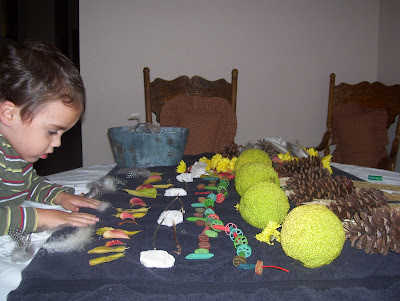

We collected pinecones, rocks, "horse" apples, sticks, leaves, guinea feathers, and seeds. Natural objects were used for patterning except for Rigatoni noodles and pinwheel pasta which make a colorful necklace when dyed.
Recipe for Colorful Pasta: In a zip bag, put 1/4 cup rubbing alcohol and at least 10 drops of food coloring and swish it around. Then, add 1 – 2 cups of pasta. Turn bag over occasionally. The longer the pasta sits - the brighter the colors. Dry on wax paper or newspaper or on cookie sheets.Children will learn about making different colors by mixing the primary colors of red, yellow and blue.
Directions for a Pinecone Turkey:
 Brody isn't sure which pinecone turkey he likes the best - using natural guinea feathers or dyed feathers. We only picked up feathers which had already fallen off the guineas. Proof the guineas are not naked is in the photo - although they did escape by flying on top of the roof.

And just for fun, we made headbands.
"Why are you wearing your hand on your head?"
"She thinks it looks like a turkey!"


- Observation: Objects have different properties
- Classifying: Sort objects
- Prediction: What comes next?
- Manipulation: Sequence of objects
- Ordering: Making sense of pattern
- Communication: Describe and express patterns building vocabulary: What shape, color, texture?
- Math: Count objects. Use simple to complex patterns - rock, leaf / rock, leaf ; red, red, green / red, red, green. Match concrete objects with verbal expression in patterning.
- Measurement: Compare and contrast objects, using terms length, weight, size
- Sensory/Motor Integration: How does it feel? Which is heavier? Move in patterns: hop on one foot, jump, spin - repeating pattern.
- Creativity: Use objects of interest to child and let them explore using their senses: seeing, feeling, smelling
- Exploration: Objects can be ordered, measured, counted, manipulated, investigated, and patterned
- Spatial Relations: Discuss relations such as in front of, behind, above, below, left-right which helps children navigate around their world. Reading is from left-to-right and from top-to-bottom.
- Recording: Make a chart of one pattern such as apples: how many are green, red, yellow?
- Connection to environment: Patterns can be observed in nature.


We collected pinecones, rocks, "horse" apples, sticks, leaves, guinea feathers, and seeds. Natural objects were used for patterning except for Rigatoni noodles and pinwheel pasta which make a colorful necklace when dyed.
Recipe for Colorful Pasta: In a zip bag, put 1/4 cup rubbing alcohol and at least 10 drops of food coloring and swish it around. Then, add 1 – 2 cups of pasta. Turn bag over occasionally. The longer the pasta sits - the brighter the colors. Dry on wax paper or newspaper or on cookie sheets.Children will learn about making different colors by mixing the primary colors of red, yellow and blue.
Directions for a Pinecone Turkey:
 Glue wiggly eyes on pinecone
 - Cut beak by folding small piece of orange paper and cutting triangle; glue on
- Wrap a pipe cleaner over top of cone, pull down and twist forming legs
- Cut two 2" pieces of pipe cleaner and twist around bottom of legs forming 3 toes to help cone stand
- Use a paint brush or pour glue on back of cone
- Push feathers into cone


And just for fun, we made headbands.
"She thinks it looks like a turkey!"

Fluffy enjoyed posing in our garden and I made a fall basket for decoration.
What other natural objects have your children patterned?
What other natural objects have your children patterned?
Would you like more inexpensive ideas, activities, and games on how children learn through play? See my new book, The Happy Mommy Handbook: The Ultimate How-to Guide on Keeping Your Toddlers and Preschoolers Busy, Out of Trouble and Motivated to Learn. For a glimpse into Kindergarten, click my Kindergarten book. Both are bestsellers and are also available on Barnes & Noble and Kobo.
I hear, and I forget. I see, and I remember. I do,
and I understand. ~Chinese Proverb

and I understand. ~Chinese Proverb

Follow me by:
Subscribe to:
Posts (Atom)